
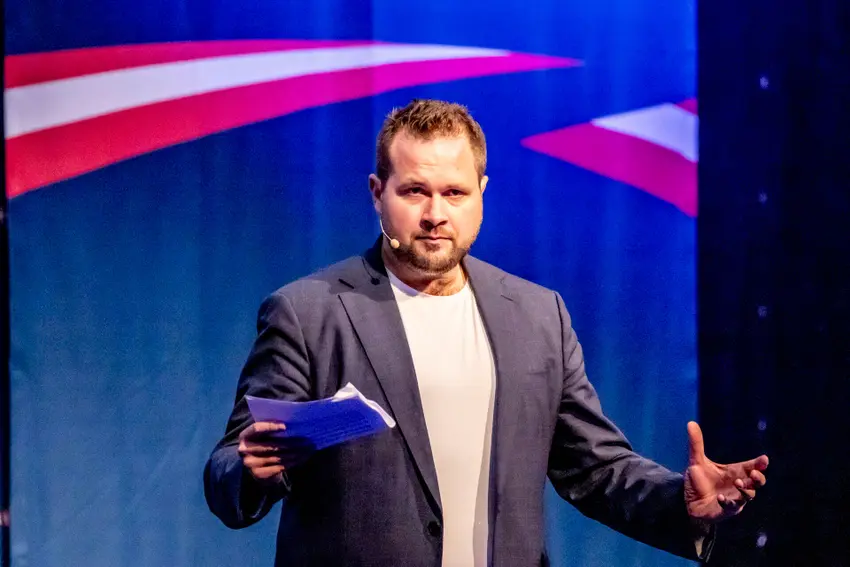
Danish MEP reaches CNN with Trump ‘f*ck off’ comment
Anders Vistisen, a member of the European Parliament from the Danish People’s Party (DF), had his say this week on US President Donald Trump’s pursuit of Greenland.
In a speech in the EU parliament, Vistisen railed against Trump for his advances on the autonomous Arctic territory, which is part of the Danish Kingdom alongside Denmark and the Faroe Islands.
“It is not for sale. Let me put it in words you might understand. Mr Trump, fuck off,” he said before being reprimanded by the parliament’s speaker for his use of an expletive.
Following the comments, the MEP from Denmark appeared on US news network CNN to explain his choice of words.
“It’s a completely unacceptable attack on Danish sovereignty to want to claim territories that have been Danish since the tenth century, three times as long as the United States has existed,” he told CNN’s anchor Erin Burnett.
The far-right, anti-immigration, national conservative DF is arguably the Danish party most likely to be politically aligned with Trump and the Republican Party in the US. That makes Vistisen’s aggressive approach somewhat surprising.
DF’s leader Morten Messerschmidt has since publicly (on social media) reprimanded Vistisen for using the phrase he did.
The explanation of Vistisen's comment can be found in DF’s differences with the government over Greenland – not in a desire within DF to criticise Trump.
This is because DF does not support Greenlandic independence. Messerschmidt has called the idea of Greenlandic independence a “mirage”, arguing that Nuuk is not capable of running a fully independent administration despite its existing autonomous system.
READ ALSO:
- INTERVIEW: 'Everything the US could want from Greenland, they already have'
- EXPLAINER: Why is Greenland a part of the Danish Kingdom?
- EXPLAINER: How easily could Greenland break away from Denmark?
The DF position appears to be rooted in a colonial mindset, in which Greenland is seen as belonging to Denmark, rather than an associated territory as is now the general (and indeed legal) view. It also fits with the right wing principle of protecting national borders – yet another parallel with Trump.
To illustrate this, witness Vistisen telling the EU parliament that Greenland has “been part of the Danish Kingdom for 800 years,” further describing it as an “integrated part of our country”.
He seems to have lost 300 years somewhere between this statement and invoking the tenth century on CNN, but let’s skip over that.
What is certain is that DF does not think the government has acted firmly enough in its response to Trump. Prime Minister Mette Frederiksen famously called discussion of Trump’s proposal to buy Greenland “absurd” back in 2019, but the government is clearly walking on eggshells this time around.
Vistisen expanded on this in his CNN interview by praising both Panama and Canada, which have both responded in firmer terms to Trump’s recent rhetorical advances on their territories.
A further element to Vistisen’s use of the ‘F’ word, which neither he nor CNN addressed, was the difference in the impact of the word ‘fuck’ in the English language compared to the Danish.
As we’ve written about on The Local several times in the past, saying f*ck in Danish is less offensive than saying it in English, because loaned swear words lose some of their impact in foreign languages.
READ ALSO:
- OPINION: Sometimes I wish my Danish in-laws would shut the f*ck up
- Why you shouldn't be surprised to hear Danish children say the F word
Vistisen was, of course, speaking English when he deployed the word in Trump’s direction – but, like most Danes who use it, he probably still underestimated how inappropriate it is, at least in a cultural sense if not a diplomatic one.
The Danish MEP told Burnett that Trump frequently uses the word himself. Even if that’s the case, and if Vistisen’s remark reaches him, he’s unlikely to be too bothered.
Signs of escalation in Baltic Sea follow PM's warnings
The Russian ship Yantar, which has been under close surveillance by the British Navy,was reported on Friday to be located just off the coast of Skagen, in international waters but near Danish territory.
The report was sourced by newspaper Ekstra Bladet using tracking data from the website Vesselfinder, and hadn’t been corroborated by the Danish military at the time of writing.
The vessel was reported to have entered the Kattegat sea overnight ahead of Friday. It departed from a port in Algeria on January 14th before passing through British waters, eliciting confrontational comments from British Defence Minister John Healey.
Healey told the BBC on Thursday that the ship is being used by Russia to collect intelligence and map critical underwater infrastructure.
“I also wanted President [Vladimir] Putin to hear this message: we see you, we know what you're doing and we will not shy away from robust action to protect this country,” he said.
Russia describes Yantar as a research vessel according to the BBC’s report, but the incident is evidence of gathering escalation in the Baltic Sea region.
Government leaders from the Nordic and Baltic countries recently met in Finland to discuss the challenges presented – mainly by Russia – in the Baltic Sea. The summit was somewhat overshadowed in Denmark by coverage of US president Donald Trump’s pursuit of Greenland, but the fact Prime Minister Mette Frederiksen attended despite the ongoing Greenland crisis is evidence of its importance to the Danish government.
Frederiksen told broadcaster DR, while in Helsinki, that she was “concerned about the Russian shadow fleet”.
Several recent incidents involving sabotage targeting power and gas cables in the Baltic Sea have led to increased attention on critical seabed infrastructure, not least Denmark’s heavy involvement in the presence of a Chinese ship which anchored in the Kattegat in December.
READ ALSO:
- ‘Shadow fleet’ oil tanker towed towards Denmark after trouble at sea
- Ship in Danish waters raises concerns over Russian hybrid warfare in Baltic Sea
This is the backdrop for the Ministry of Defence’s announcement on Thursday that Denmark is to contribute jets and navy vessels to support Nato operations in the Baltic Sea.
A key goal of the Nato mission is to protect critical infrastructure, such as underwater cables and pipelines.
“Intensified surveillance [of the Baltic Sea] will be done with aircraft and ships with periodic operations and in ongoing coordination with Nato and Baltic Sea allies,” the Defence Ministry said.
That followed Frederiksen’s comments last week that she agrees with Nato’s general secretary, Mark Rutte, that member states should now spend over 2 percent of their GDP on defence.
“I agree with [Rutte’s] basic analysis. I don’t believe 2 percent is enough. I said so in my New Year speech very recently: that we’ve already armed ourselves a lot, we’re going to arm ourselves more, and it’s going to be very expensive,” she said.
Which New Year comments was she referring to? Here’s a quote from the PM’s January 1st speech:
“In the world we’re looking at now, you can win or you can lose. If you don’t have the will to win, you’ll lose,” she said at the time.
She went on to say that “Moscow, Pyongyang and Tehran” are “three capital cities in three countries which are working more and more closely. Against us”.
Comments