
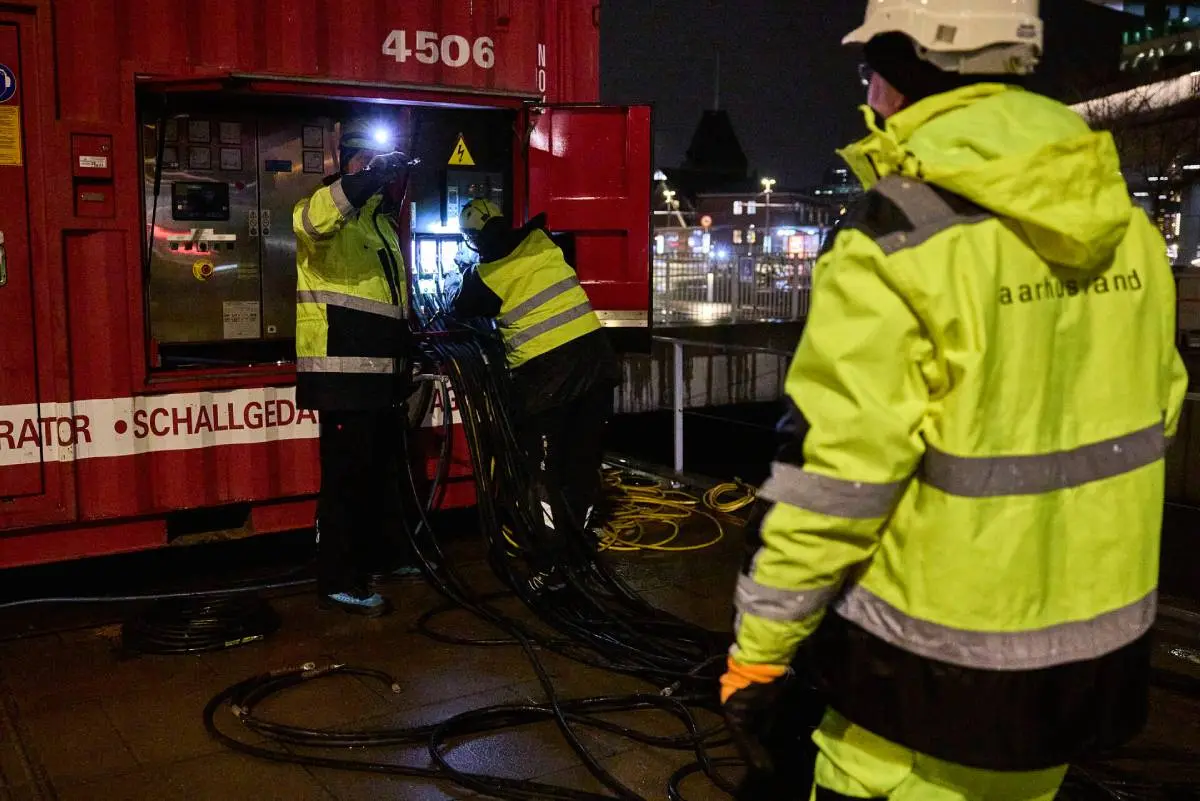
Coastal areas face flood risk
Residents in the southern part of the Kattegat area and adjacent fjords should be prepared for flooding on Friday as elevated water levels threaten coastal and low-lying regions.
The Danish Meteorological Institute (DMI) predicts water levels ranging from 150 to 190 centimetres.
To assess the flood risk in your area, you can use the state-supported KAMP tool. Adjust the slider for "Elevated water level in metres" to match the expected maximum water level in your area.
By zooming in on the map, you can pinpoint affected regions, with indicators highlighting buildings and roads at risk.
Great Belt Bridge reopens to car traffic after storm closure
Following its closure due to the impact of Storm Pia on Thursday evening, the Great Belt Bridge - which connects the Great Belt strait between the Danish islands of Zealand and Funen - has been reopened to car traffic, according to the state-owned construction company Sund & Bælt.
Despite the reopening, strong winds continue to affect the area and are expected to impact driving conditions.
Additionally, there is still a restriction on the passage of trailers weighing less than 2500 kilos, which is expected to be lifted on Friday morning.
The Great Belt Bridge is not the only one affected by the storm. Crown Prince Frederiks Bro in Frederikssund has been closed since Wednesday and is not expected to reopen until Saturday.
The Farø Bridges, two road bridges that connect the islands of Falster and Zealand, briefly reopened before 5 am on Friday morning, but tall and light vehicles and trucks weighing less than ten tonnes are still not permitted to pass.
According to information from the Danish Road Directorate's website, wind-sensitive vehicles are also advised to avoid crossing the Vejlefjord Bridge between Mølholm and Nørremarken.
Christmas in Denmark to be wet instead of white
This Christmas in Denmark, it's more likely to be a wet affair than a snowy one, according to Mette Wagner, a meteorologist at Denmark's Meteorological Institute (DMI).
The forecast for Sunday, December 24th, suggests that Southern Jutland could experience temperatures as high as ten degrees Celsius, making it grey and rainy rather than a white Christmas.
Thus, this year, the prospects of snow are not looking promising.
DMI defines a white Christmas as having more than 90 percent of Denmark covered in snow on the afternoon of December 24th, with a snow depth exceeding half a centimetre.
According to DMI records, Denmark has experienced a white Christmas only nine times since 1900, with the last occurrence in 2010 when temperatures dropped below ten degrees below zero, resulting in snow cover ranging from a few centimetres in parts of Jutland to over a meter on Bornholm.
Storm Pia drives down electricity prices in Jutland and Funen
After making landfall on Thursday afternoon, Storm Pia also made its presence felt in Denmark by setting the nation's wind turbines into rapid motion. As a result, electricity prices plummeted, bringing a windfall for consumers in Jutland and Funen.
READ MORE: How is Storm Pia affecting travel in, to and from Denmark?
Morten Wethje Søndergaard, the head of Nordic trading at Norlys Energy Trading, said that electricity prices reached remarkably low levels during the late-night hours between midnight and 7 am.
"In Jutland and Funen, the electricity price - without taxes and fees - virtually reached zero," Wethje Søndergaard said.
According to forecasts, the Danish wind turbines are expected to be most productive between Thursday afternoon and Friday afternoon.
As the storm gradually subsides on Friday and weakens further over the Baltic countries on Christmas Eve Saturday, the dip in electricity prices will likely disappear.
Comments