
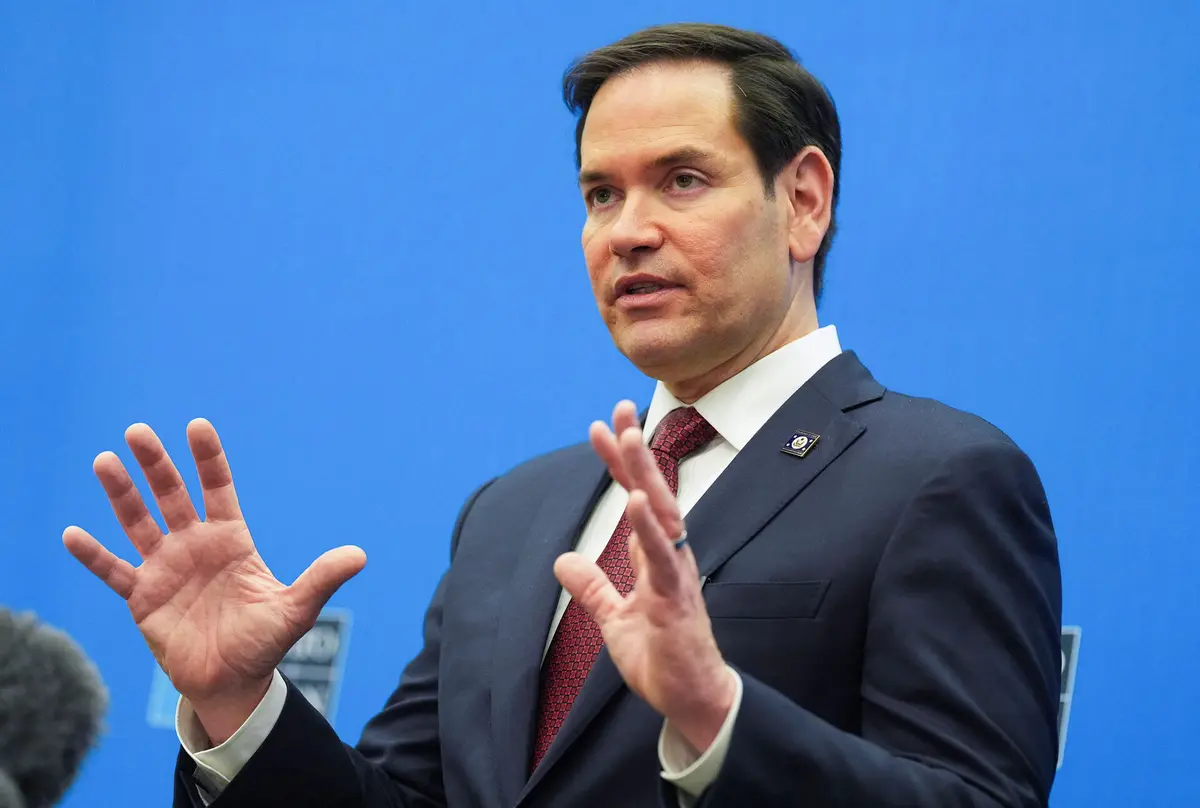
"What we're not going to do is let China come in now and offer them a bunch of money, and become dependent on China," Rubio told journalists after a NATO meeting in Brussels, the AFP news agency reports.
He also said that Greenland will eventually make a "decision" over its future and wanted independence from Denmark, echoing a line from Vice President JD Vance, who on Thursday again criticised Denmark, repeating the accusation that it had "underinvested in the infrastructure and security" of the autonomous territory.
"I think they want to be independent from Denmark, and then once they do that, we can have a conversation about the relationship we'll have with the United States and Greenland," Vance told far-right cable news channel Newsmax.
Neither Vance nor Rubio appeared to acknowledge that a large majority of Greenlanders oppose becoming a part of the United States, according to polls.
The new comments from Rubio are likely to undo steps taken earlier towards improving US relations with Denmark, given Rubio on Thursday had reassured his Danish counterpart Lars Løkke Rasmussen of the "strong" ties between the two countries.
Tensions remain high between Copenhagen and Washington over the latter's territorial threats against Greenland.
"Secretary Rubio reaffirmed the strong relationship between the United States and the Kingdom of Denmark," a US statement said after a meeting on the sidelines of a NATO meeting in Brussels on Thursday.
The statement did not say if there had been any discussion about Greenland, which President Donald Trump has repeatedly vowed to seize control of against the wishes of the Greenlandic government and people.
The US statement said Rubio's talks with Denmark's foreign minister Løkke focused on "shared priorities including increasing NATO defense spending and burden sharing, and addressing the threats to the alliance, including those posed by Russia and China."
Løkke has previously said the narrative pushed by the Trump administration that Greenland was coming under Chinese influence due to investments was misleading.
“We do not recognise the impression that some people in American political circles seem to have, that Greenland is a place full of Chinese investments. As far as I know, there are none,” he said last week.
Following the meeting between the two in Brussels, Løkke said he had made it clear to his American counterpart that the statements about Greenland need to stop.
“I obviously took the opportunity to make a few things very clear on behalf of the [Danish] Kingdom,” he said to the Ritzau newswire.
“That is, these ongoing remarks from the American president expressing an ambition to take over Greenland are in no way sustainable,” he said.
This appears to have had no effect on the Trump administration, however.
Danish Prime Minister Mette Frederiksen meanwhile said in Greenlandic capital Nuuk that the United States "cannot annex another country."
Frederiksen made the comments in English as she visited the autonomous territory, which forms part of the Danish kingdom.
The PM arrived in Greenland on Wednesday for a three-day visit, aiming to show support and unity in the face of US threats.
She rode around the capital Nuuk in a Danish navy patrol boat, alongside Greenland's new prime minister, Jens-Frederik Nielsen and his predecessor Mute Egede.
Observers say her visit will reassure the island of 57,000 people, the vast majority of whom, polls show, want to become independent from Denmark but do not wish to become part of the United States.
"I think it's very, very important and it's very reassuring for Greenlanders to see a Danish head of government," Mikaela Engell, an expert on the Arctic territory who previously served as Denmark's High Commissioner to Greenland, told news agency AFP.
Earlier this year, "the Danish government was almost invisible," she said, describing Copenhagen's efforts as tip-toeing, trying to accommodate US interests and not antagonise Trump.
But after the general election and Vance's visit last week to the Pituffik military base, the "gloves have come off," Engell said.
Marc Jacobsen, a researcher at the Royal Danish Defence College, told AFP that the visit would give Copenhagen an opportunity "to show coherence, to show support, to talk about what can they do more concretely, both in terms of how to respond to the United States, but also in terms of concrete cooperation investments."
Frederiksen is also expected to maintain the position laid out earlier by Denmark's foreign minister "that it is possible to enhance US military presence" under a 1951 defence agreement.
Comments