
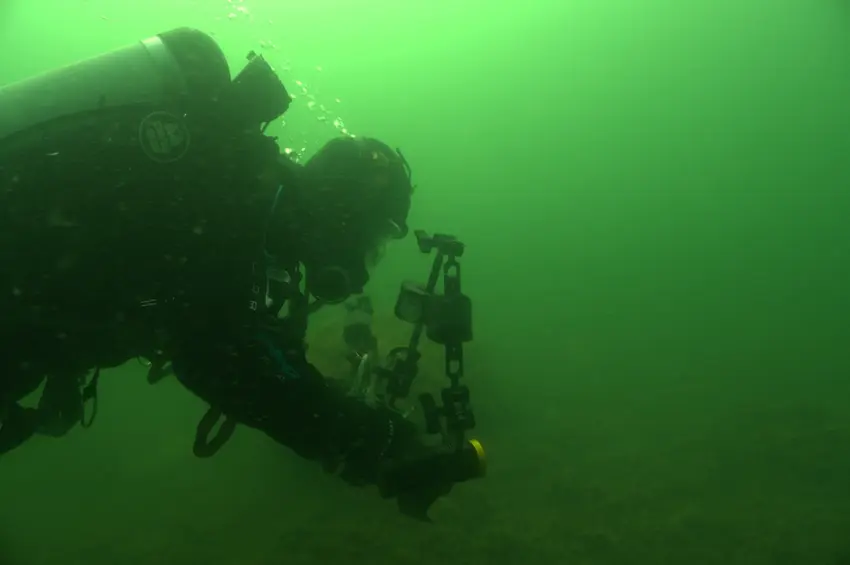
The Danish ship Øresund was wrecked off India's southeastern coast near Karaikal in Puducherry in 1619.
Rasmus Abildgaard Kristensen, Denmark's ambassador in New Delhi, said the project would see the countries "join hands" to investigate the remains of the ship, he said on social media on Wednesday.
Researchers hope the investigation will provide fresh insights into early Danish trading activities in India, a period often overshadowed by the larger colonial histories of Britain, France, Portugal and the Netherlands.
The Archaeological Survey of India and Denmark's National Museum in Copenhagen signed an agreement on Monday for a "joint underwater archaeological investigation" of the Oresund.
"The Øresund occupies a significant place in maritime history as the first Danish ship known to have reached India," New Delhi's Ministry of Culture said.
Denmark built its first trading post in India in 1620, a year after the Øresund sank at Tranquebar, today the town of Tharangambadi in Tamil Nadu, where the Danish fort is now a museum.
European links with India are often seen as beginning in 1498, when Portuguese sailor Vasco da Gama sailed via Africa's southern tip to Calicut – today the city of Kozhikode in Kerala.
But Europeans had indirect contact with India through trade networks for centuries before that via Arab, Persian, and Mediterranean merchants through the Red Sea.
Last year, India's navy sailed a traditional 20-metre (65-foot) long "stitched" wooden ship – whose hull was sewn together with coconut coir rope – to Oman.
That journey, intended to replicate journeys taken more than two millenia ago, evoked a time when Indian sailors were regular traders with the Roman Empire, as well as the Middle East, Africa, and lands to the east.
Comments