
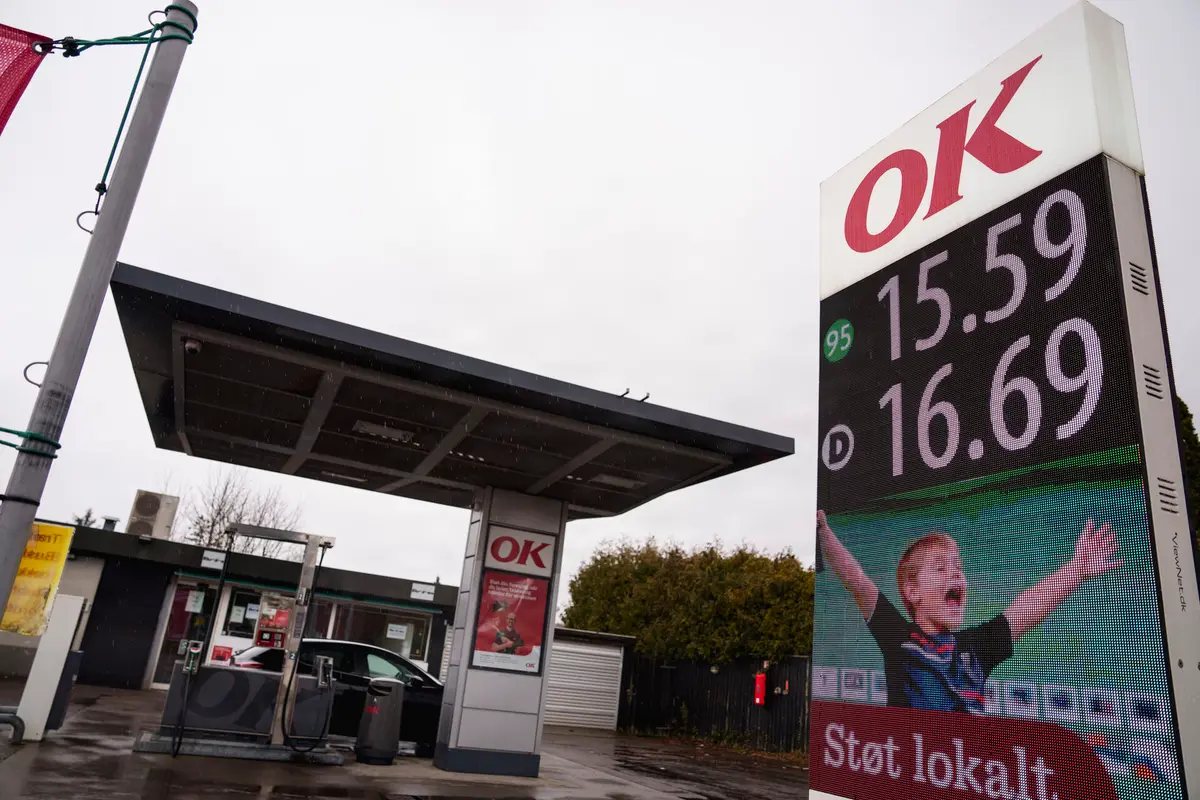
Although talks to put a new Danish government in place are dragging on, there is nothing to stop the interim government from cutting fuel taxes to counter ongoing high prices, according to experts who spoke to broadcaster DR.
Neighbouring Norway’s parliament recently decided to remove the country’s road usage tax (veibruksavgift) on petrol and diesel from April 1st until September 1st.
The Norwegian measure saw petrol prices drop by around 5 Norwegian kroner per litre, and diesel by around 3 kroner per litre.
Opposition lawmakers outflanked the Norwegian government to pass the measure, with the Centre Party breaking ranks with the government.
"The world is different now than it was in November and December. Back then, there was no war in the Middle East,” Centre Party leader Trygve Slagsvold Vedum told broadcaster NRK as he defended the decision.
Sweden – already a cheaper country to buy petrol and diesel than Denmark – has also announced reductions to fuel taxes.
Elsewhere in Europe, Spain and Italy are also among countries to have enacted measures to reduce fuel prices.
Rival Danish parties discussed the topic in the lead-up to the March election, during which the Liberal (Venstre) party said it would cut fuel taxes and the Social Democrats, led by interim prime minister Mette Frederiksen, said they were open to various measures.
Because negotiations are ongoing to form a new government, there is no formal majority in parliament at the current time to be able to pass new legislation.
However, wheels can be set in motion to ease the effects of high prices on consumers without a majority in parliament, Professor of Constitutional Law at the University of Southern Denmark, Frederik Waage, told DR.
“There’s nothing to stop a bill being tabled if there’s a majority for it,” he said.
The previous government, which handed in its resignation after the election, can no longer table legislative proposals in parliament.
However, individual parties can still make private forslag or “private proposals”, he said.
“Parliament’s order of business does not prevent bills actually being passed within a day in urgent cases, and that’s also the case in relation to private proposals,” he told DR.
However, the professor said he was not aware of any previous instances of new laws being passed in this way.
“There’s nothing I’m aware of in recent constitutional law history,” Waage told DR.
“But we appear to be facing a long period in which we don’t have a government. So it might be necessary to do it if you want to follow other countries on this point,” he said.
“There’s no doubt it would be an unusual method, by my assessment is that this would be the only thing that can be done in a situation in which the government has resigned and ministers are only interim,” he said.
Comments