
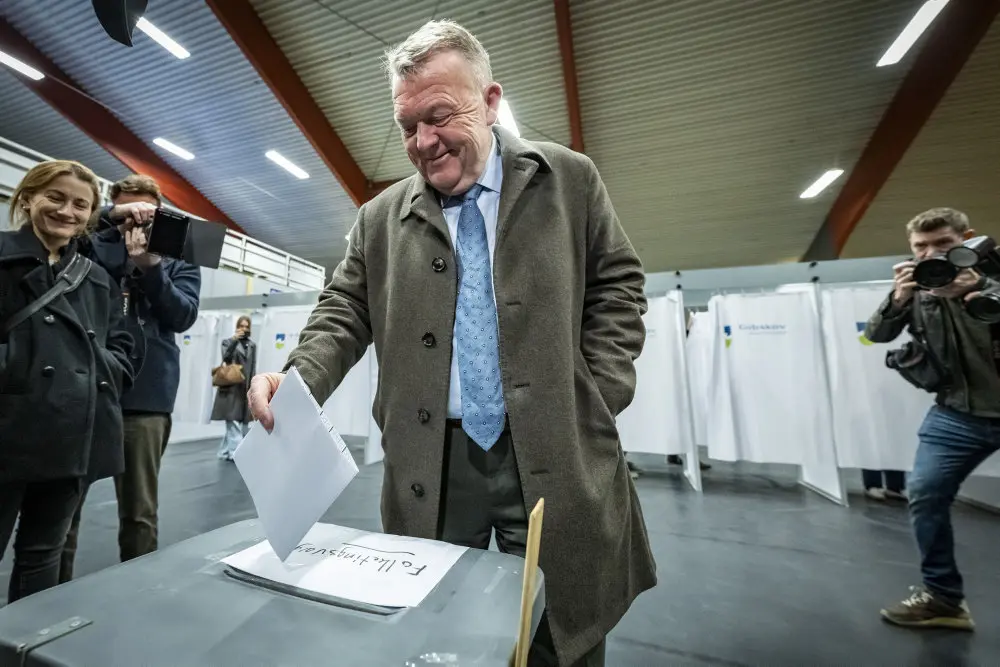
Løkke, who led Denmark as Prime Minister from 2009-11 and 2015-19, said that he does not want to lead the government again but will back himself as the so-called kongelig undersøger, which roughy translates to ‘royal investigator’.
This intriguing-sounding title is more mundane than you might think. It means the member of parliament given responsibility for forming a government after an election.
If they do this successfully, they usually become prime minister – so Løkke’s assertion he does not want this part of the job was notable, if in keeping with the ex-PM’s flair for leftfield strategic moves and breaking with convention.
Let’s take a couple of steps back to clarify the terminology.
The winning party leader is likely to become kongelig undersøger. ‘Winning party’ in this sense means the party that gets the most votes within either the left or right wing ‘bloc’ that takes an overall majority in the election.
The kongelig undersøger is found through a so-called kongerunde or ‘King’s round’ (previously dronningerunde when Queen Margrethe was still monarch), whereby each of the parties goes to the King and nominates a candidate to attempt to form government.
Because each party will usually pege på (meaning ‘point to’, essentially nominate) a preferred party leader to lead the government, the bloc with the largest vote share will normally come together and nominate the leader of the largest party within its group, putting them in the driving seat to form the new government.
Additional kongerunde can happen if the negotiations are unsuccessful, opening the door for a different party leader to get the nod. This could happen if, for instance, the result is very close, if parties switch allegiance or a coalition is formed across the centre, thereby breaking the ‘bloc’ system of alliances.
The procedure of holding audiences with the King to nominate a lead negotiator is largely ceremonial (the King's role in it is at least), but the negotiations themselves can become protracted.
In 2022, several weeks passed between the election and the eventual agreement which formed the basis of the coalition government.
Once a new prime minister and government is in place, they are formally nominated by the King at Amalienborg Palace in Copenhagen before emerging and facing the public on the palace square.
Which brings us back to Løkke.
“I’m not a candidate to become prime minister but I have said that I would very much like to be at the forefront of attempting to form a platform for how a government might take shape,” he told news wire Ritzau after casting his vote in his home town of Græsted in North Zealand on Tuesday.
“That is because I’ve seen how polarised it has become since (Prime Minister) Mette Frederiksen blew the half-time whistle,” he said, referring to Frederiksen’s decision last month to call the election.
“Someone has to take responsibility for uniting Denmark,” he said.
The Moderates are the only party openly calling for a left-right coalition similar to the outgoing government.
The Liberal party, led by Frederiksen’s main rival for PM Troels Lund Poulsen, wants to lead a centre-right government while Frederiksen has made overtures towards both the left and the centre during her campaign, without definitively stating a preference for either.
The final poll ahead of Tuesday's Danish general election shows the left-leaning 'red bloc', led by Frederiksen's party the Social Democrats, slightly ahead on vote share but with no clear prediction for a winner.
The red bloc is polling at a total of 48.3 percent, or 85 seats, while the blue bloc is polling at 44.6 percent, or 78 seats. In both cases, this falls short of the 90 seats needed for an overall victory.
The Moderate party, who look like they will get 7.1 percent of the vote and 12 seats, are not aligned to either bloc and could therefore play an important kingmaker role.
It’s here that Løkke’s strategy of becoming chief negotiator comes into play, because it could help him to maximise the sway his party’s seats can have.
Commentators have noted that Frederiksen, as a likely kongelig undersøger, is also skilled at getting results over the line and so should she become chief negotiator, Løkke risks seeing his influence diminished.
However, given the possibility that the election will return an inconclusive result, the two-time prime minister may have talked himself into some additional leverage.
Comments