
The number of international workers in Copenhagen has more than doubled in just ten years, but official city statistics recently showed the capital is struggling to hang on to many of them.
National data from Statistics Denmark show that although the number of people leaving Denmark has increased over the past three years, this has been more than matched by a corresponding increase in arrivals.
We asked readers of The Local who have left Denmark after a spell living in the country about their experiences.
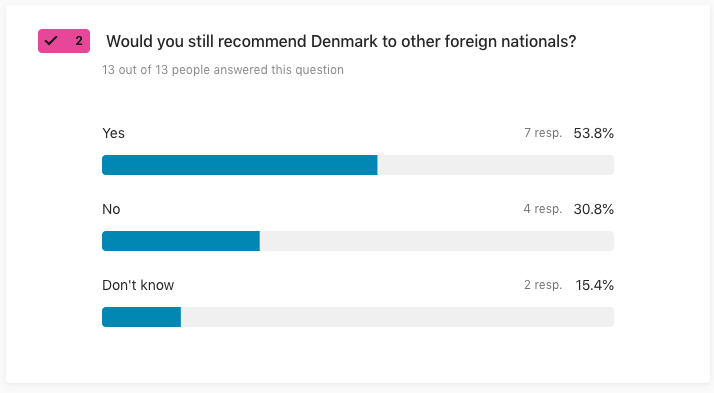
While the majority who have left said they’d still recommend Denmark to other foreign nationals thinking of moving here, many described the difficulties that had been involved in them leaving.
Some of our respondents pointed to workplace challenges as being a major factor in them leaving Denmark.
“We (I and my wife) lived in Copenhagen, Denmark for five years. We moved there for a work opportunity. However, after spending some good years it started feeling quite routine and boring,” said an anonymous reader, who moved to the country from Germany.
“Also, there are not many companies to move around if you want to explore different opportunities,” they said, explaining that they eventually decided to take up another job offer outside of Denmark but still in Europe.
Breaking into the Danish labour market can meanwhile be notoriously difficult if you arrive in the country for reasons other than a job offer.
“I’ve been living in Denmark for four and a half years. I’m a management consultant with 14 years of experience at a Big Four firm in my home country,” wrote Salvia from Italy, who still lives in Denmark but said she was planning to leave as soon as possible.
“Despite my background and skills, it has been extremely difficult to secure a position aligned with my professional profile,” she wrote.
After she came to Denmark with her 14-year-old son, hoping to take advantage of Denmark’s educational opportunities, she said that they both “faced unexpected challenges related to cultural fit, access to networks, and hidden biases that continue to shape our experience at school and work.”
“I’ve also come to realize that some of the ideals often associated with Danish society, such as equality, openness, janteloven, or ‘hygge’ — can sometimes feel reserved for those who fully belong to the social majority,” she said.
“At the same time, my son met incredible young people in the gymnasium [upper secondary school, ed.] who are more open-minded, globally aware, and ready to build a more inclusive future than previous generations,” she added.
“We’re still here, committed to making this experience work — adapting, learning, and doing our best to contribute meaningfully while navigating the reality of integration,” she said.
Even people from countries culturally close to Denmark said they had found adaptation, and breaking into the jobs market, to be a challenge.
“Denmark never ‘clicked’ for me and I didn't ever feel welcome,” wrote Albert Thor Thorhallsson from Iceland, who spent three years in a postdoc position at a Danish university. He now lives in France.
“The jobs that were available for my education didn't pan out and so I had to leave as I would run out of money living in Denmark,” he said.
“Denmark doesn't want foreigners, it is Denmark for Danes all the way,” he added.
A reader from Portugal contacted us to say that she and her Danish partner eventually decided to raise their children in the southern European country, rather than the Nordic one.
“I lived in Denmark (Aarhus and Esbjerg) for seven years. I started in Aarhus as a master's student and then applied for - and was granted - a PhD position at SDU in Esbjerg,” explained Ana Madsen, who now lives in Porto.
“When the PhD ended we decided that it was time to move south and I got a position as a degree director at a Portuguese university,” she said.
“The distance between Denmark and Portugal is only 3,000 kilometres, but culturally is very different!”, she said.
“Our two daughters are trilingual (Danish, Portuguese and Inglês) and adapted really fine … in the sunny country,” she said, admitting the weather in Portugal was a factor but that there were also other reasons.
“Food habits, hours to eat, the concept of family,” were all listed by Madsen as areas where Portuguese customs worked better for her family.
READ ALSO: Why do Danes eat lunch so early?
“For quite a while I had been trying to find a job in Denmark but had had no luck, no responses and certainly no interviews,” wrote Jill from Yorkshire in the UK, who left Denmark after six years following a divorce.
“In contrast to Denmark, I get replies from English employers, and the whole process of applying for jobs seems fairer and based on equality,” she said.
After her time in Denmark, Jill concluded that it is “a nice country to live in but it is very clear that they are not overtly fond of internationals.”
“I also think the culture is a little 'cold',” she said.
“Making conversation with Danes, even in Danish, was painful and extremely hard work. If you like meeting people, and open cultures then Denmark is perhaps not for you!,” she said.
“While the UK has its problems I do find the cultures here more welcoming than in Denmark,” she said.
That last sentence hit a note with which several other responses also chimed.
“Denmark is a lovely country and one that I miss living in, but it is hard to integrate,” wrote Daniel Stabler from the UK, who studied at Roskilde University and stayed on after graduating, but now lives in Australia.
“Denmark is a nice country for Danes but difficult for immigrants,” said Kamile from Lithuania, who left after eight years because “it is hard to find a job even though I have graduated university here, hard to connect with people and always feel like you don’t belong here.”
For others, the reasons were straightforward and not directly related to Denmark.
“I left to see more of the world,” said a reader from the UK who lived in Denmark for two years before moving on to Australia.
Not everyone who left Denmark did so because they experienced difficulties with the country’s labour market, culture or other factors.
Some, whose work led them elsewhere, said they would highly recommend Denmark to others.
“I have lived [in Denmark] for three years and was on contract basis software engineer at an IT company,” wrote Pooja from India, who described his time in Copenhagen as the “best years of my life.”
“It was my decision to come back because of family dependency in my home country,” he explained.
“I always recommend Denmark” he said, citing the country’s work-life balance and “connection with nature”
“The only scary part is winter depression and loneliness for foreigners,” he said.
Comments