
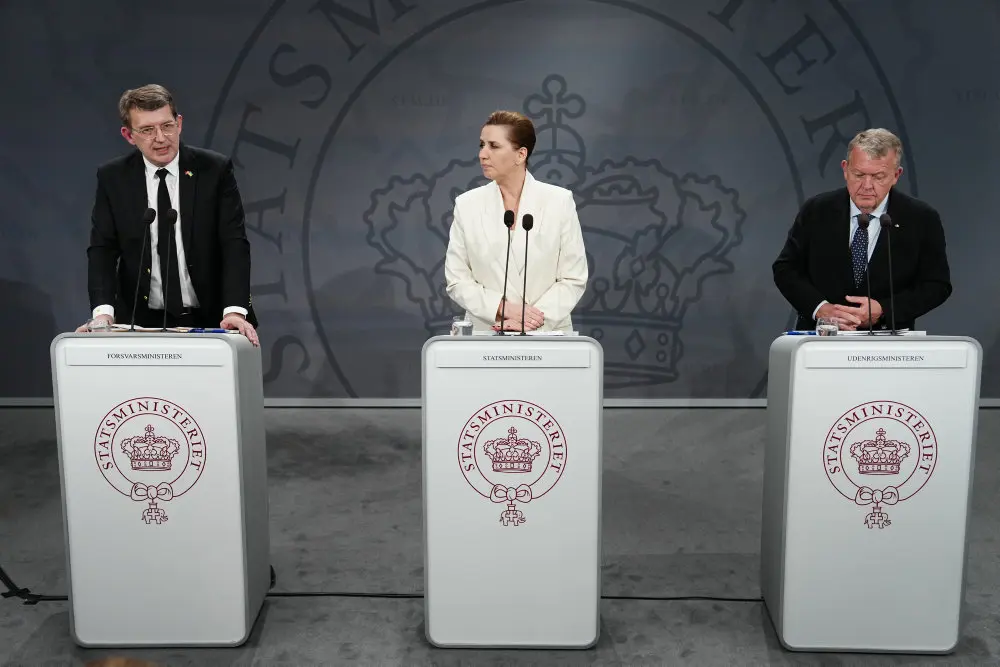
Frederiksen told a press conference that the money was being sent to the military with the message: "Buy, buy, buy. Buy what can contribute to a stronger defence and thus to a stronger deterrence here and now. If we can't get the best equipment, buy the next best thing."
Some 25 billion kroner will be this year, with the remaining 25 billion set aside for 2026.
The funds will be placed in what the government calls an "acceleration fund" for rearmament amid what the government describes as an increasing threat to European security from Russia.
February 24th marks three years since Russia invaded neighbouring Ukraine. Moscow had already seized control of Ukraine’s Crimean Peninsula in 2014.
Frederiksen stressed that Russia remains a serious threat.
"We are facing an aggressive Russia that is rearming and perhaps preparing to attack others," she said.
The PM said that "we are in the most dangerous situation in many years" due to the Russian threat.
That makes it necessarily to make major investments in the Danish military, she said the briefing, which was also attended by Defence Minister Troels Lund Poulsen and Foreign Minister Lars Løkke Rasmussen.
"Buy whatever can immediately strengthen our defence and deterrence. If we can't get the best equipment, buy the second-best," she said, addressing the acting head of the military Michael Hyldgaard.
Details on what powers the military chief will have in procurement will be revealed on Thursday, Poulsen said, while also confirming that the head of the military will be given greater authority over future acquisitions.
The Defence Ministry’s procurement agency, Forsvarsministeriets Materiel- og Indkøbsstyrelse, will be restructured, Poulsen added. Mistakes will become more likely due to a deliberate speeding up of the procurement process, the minister acknowledged.
"I would rather make mistakes and carry out the necessary military buildup than sit around doing nothing," Poulsen said.
Earlier on Wednesday, the Finance Ministry announced that Denmark's budget leeway, the so-called finanspolitisk råderum, will have increased by 21.25 billion kroner in 2030. This is an economic projection that estimates how much funding parliament will have available for new initiatives or potential tax cuts.
This increase, along with a loosening of fiscal policy, will help finance the additional defence spending, the government said.
Comments (1)