
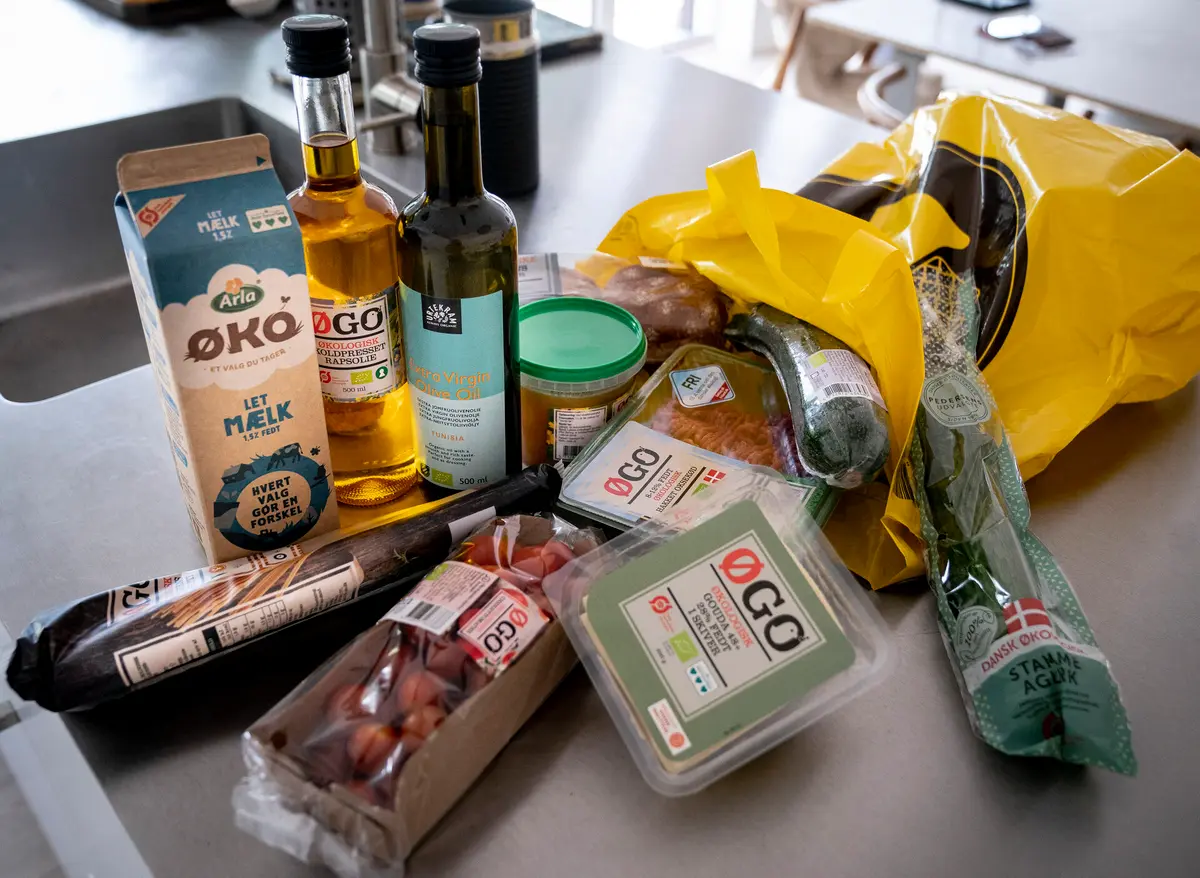
If you regularly buy food at Danish supermarkets, you have probably noticed how high the prices of certain items are.
Olive oil, for example, can be expected to set you back 90 kroner for a bottle which would have been priced at around 50 kroner prior to 2022, as broadcaster DR points out.
Sugar, butter, chocolate and orange juice are also among products whose prices have skyrocketed by as much as 50 percent since Danish consumers were hit by high inflation two years ago.
The inflation was a direct result of raised energy prices linked to the war in Ukraine, which started in February 2022.
But although energy prices are now under control, consumers are still paying far more than they used to for everyday food items.
Food products are currently 22 percent more expensive on average than they were in January 2022, when inflation began to rise, newspaper Jylland-Posten reports.
An index used to monitor food prices, Forbrugerprisindekset, is now at its highest level and economists say they we should not expect prices to ever return to their pre-crisis levels.
“Inflation may well have run out of steam but prices are still going up, albeit in smaller increments and from a much higher level. And they are not coming down again,” Danske Bank’s senior economist Las Olsen told Politiken.
Data from Statistics Denmark, reported by DR, show that the price of frozen fish has gone up by 5.8 percent in the last month alone.
Several factors are to blame for the ongoing increase in food prices Sydbank’s consumer economist Ann Lehmann Erichsen told DR’s P1 Morgen radio programme.
“At the start it was the after-effects of the Covid pandemic. Then came the war in Ukraine and we saw energy prices and electricity prices running away,” she said.
Central banks subsequently raised interest rates, making it more expensive for farmers and other producers to borrow money to increase their production.
Higher costs for producers have now transferred to the prices being demanded of consumers.
In addition to this, climate and supply issues have affected several product groups.
“We have a climate crisis that makes it rain to much for the crops in some places, and not enough in others,” Lehmann Erichsen said to P1.
A poor olive harvest in Spain last year is one such example, DR states, while coffee may soon be impacted.
“Not very much coffee is being produced at the moment because of drought in Brazil and Vietnam, but we’re not about to stop drinking coffee,” Lehmann Erichsen said.
“We’re seeing it with butter at the moment. It’s become very expensive and it will soon also be expensive to buy cheese,” she said, citing falling production of milk.
A senior economist for consumer organisation Forbrugerrådet Tænk, Morten Bruun Pedersen, said prices “rise like a rocket and fall like a feather” in comments to the broadcaster.
Because consumers get used to the new prices, supply chains can be inclined to add a percentage or two to their prices to take the “new normal” into account, he suggested.
But Lehmann Erichsen downplayed this, saying it was “a debate that has gone on for a long time, but there’s nothing to suggest there are booming results at supermarkets, which there would be if they were scoring the biggest profits,” she said.
An analysis by the Danish Chamber of Commerce last year showed that stores had not initially sent the full weight of increased costs charged to them by producers on to customers.
The organisation’s deputy director Henrik Hyltoft told DR that “the buffer that the retail sector has provided for consumers is now beginning to fade”.
“As a consumer you can be pleased that you’ve had a ‘discount’ for a couple of years so that wages could be regulated in the right direction in the meantime,” Hyltoft said.
Comments (1)